
Understanding Your Own Relationship with Change
Mar 30, 2026
I would like to consider myself an innovative person.
Before you picture someone queuing overnight for a phone release, let me clarify what I actually mean by that. My brain is wired for problem-solving. I naturally make connections between seemingly unrelated ideas, and I think in systems, always tracing how one variable influences another and how small shifts in behaviour can ripple outward in ways we don't always anticipate.
When something new lands in front of me, whether that's a change in how I run my clinic, a new approach to breathwork, or a piece of technology promising to streamline my workflow, I don't panic. I don't dismiss it either. I take a moment to place it within my existing frame of reference and ask: where does this fit? What problem does it solve? Does it move me closer to where I want to go? And crucially, I don't need it to be perfect before I say yes.
I've come to understand that this is a particular kind of relationship with change. And it isn't everyone's. Honestly, it shouldn't be.
Human beings are wonderfully varied in how they respond to change. What feels energising and natural to one person feels overwhelming and threatening to another. Neither response is wrong. Understanding the difference, though, is one of the most practically useful things I've come across, both as a clinician and as someone who has spent a long time trying to understand my own patterns.
Why some ideas spread and others don't
In 1962, a communication scholar named Everett Rogers published a piece of work that has stayed with me since I first encountered it. His central question was deceptively simple: why do some ideas spread, and others don't?
Rogers found that when any new idea, behaviour, or technology enters a population, adoption doesn't happen all at once. It ripples outward in a predictable, observable pattern across five distinct groups of people. Each group has its own relationship with change, its own internal logic, and its own set of conditions that need to be met before something new becomes genuinely possible.
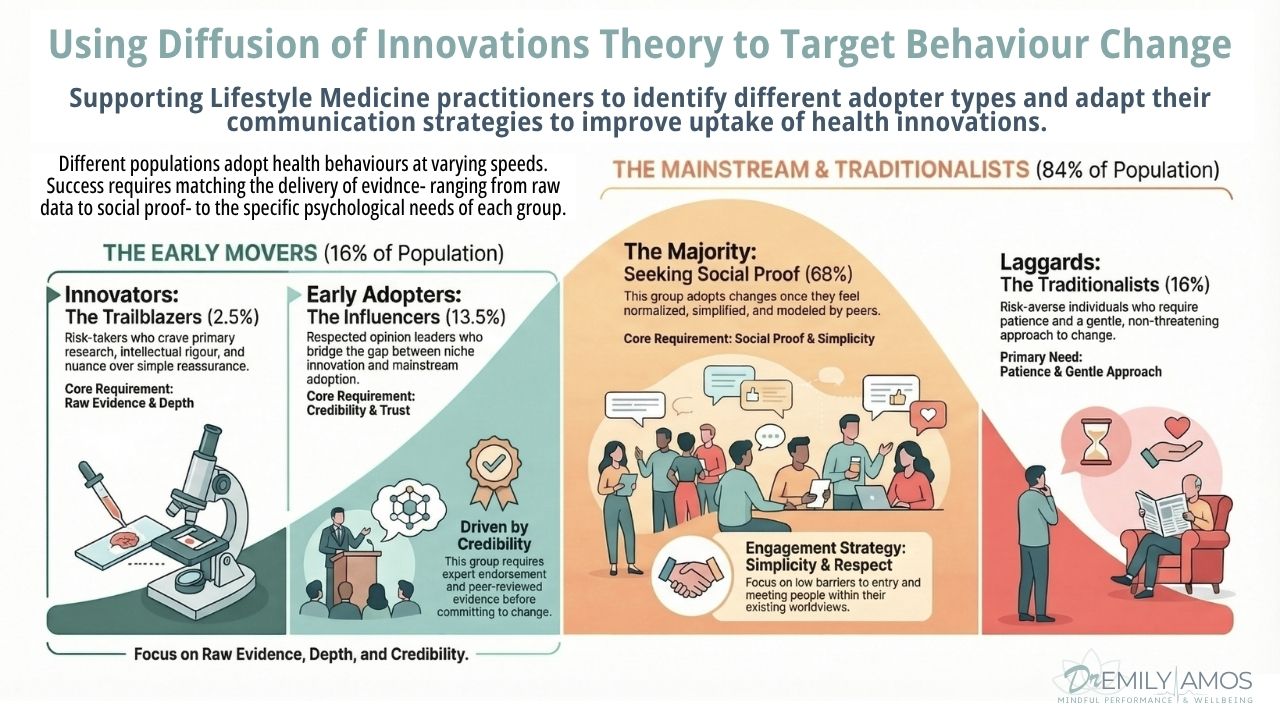
What I want to offer you here is not a framework for changing other people. It's an invitation to recognise yourself. Because understanding where you naturally sit within this model is genuinely illuminating. Not as a judgment. As information.
The five groups
The first group Rogers called innovators, roughly 2.5% of the population. These are the people who engage with a new idea before anyone else has validated it. They'll commit to a structured approach based on early but promising research, or explore an emerging practice long before it enters mainstream conversation. They have a high tolerance for ambiguity and are motivated by curiosity rather than social proof. They don't need to see something working for someone else before they try it. The possibility is enough.
The second group, early adopters, make up around 13.5% of the population and are arguably the most influential of the five. They're not quite as experimental as innovators. They prefer to see a degree of evidence before committing. But once they're convinced, they move with conviction, and they tend to bring others with them. These are the people their communities quietly look to: the friend whose opinion you trust, the colleague whose recommendation carries weight. When early adopters integrate something into their lives, the people around them notice.
Then there's the early majority, on of the largest single groups at around 34%, and the point where real cultural shift either takes root or stalls. The early majority are thoughtful and practical. They look to early adopters for cues and want to see something working for real people, people like them, before they invest their time, energy, or trust in it. Social proof carries more weight than abstract research. They often understand, intellectually, that a change would serve them. What they need is to see it lived, before they can fully commit to it themselves.
The late majority, also around 34%, tend to adopt new things largely because the social pressure to do so eventually outweighs the discomfort of changing. They are not stubborn, but they are cautious, and often for good reason. Many have encountered health trends or institutional changes that promised transformation and delivered very little. That history produces a healthy, if sometimes inconvenient, resistance to the new. The tipping point for this group is not enthusiasm. It is normalisation. When something stops feeling like a trend and starts feeling like a standard, they begin to engage. What works here is simplicity, and the lowest possible barrier to entry. Not a dramatic overhaul. A single, manageable, achievable step.
And then there are laggards, roughly 16% of the population, which is a label that sounds pejorative and frankly doesn't deserve to. These are not people who are ignorant or resistant to reason. They have a particular relationship with change, one that prioritises the known over the new and the proven over the promising. Change feels genuinely threatening to them, and that response deserves respect, not impatience. Their framework has served them. Sometimes the most useful thing available to any of us, ourselves included, is to plant a seed quietly and leave the door open, without expectation.
What this means for you
Here's the thing Rogers' work gave me that I didn't expect: it made me more patient. Not just with other people's pace of change, although that too. With my own.
Because the model also tells us that each group is responding logically, according to their own internal architecture. The innovator who charges ahead isn't reckless. The laggard who holds back isn't obstinate. They are both behaving in ways that are entirely consistent with how they are wired to process risk, uncertainty, and the unknown.
If you're reading this and you recognise yourself in the early majority or the late majority, I want to say something clearly: there is nothing wrong with needing to see something working before you try it. There is nothing wrong with needing time, social proof, or the simplest possible entry point before you can genuinely commit to a change. That isn't weakness or resistance. It is a perfectly legitimate relationship with the new.
And if you're an innovator who has ever felt frustrated watching the people around you move slowly toward something you adopted two years ago... this framework might offer a little grace there too. They are not where they are because they haven't heard you. They are where they are because they are a different kind of thinker, in a process that has its own timeline.
Understanding your own relationship with change, naming it honestly and without judgment, is not a small thing. It is the beginning of working with yourself rather than against yourself.
And in my experience, that is where most sustainable change actually starts.
Stay connected with news and updates!
Join the mailing list to receive the latest blogs, news and updates.
Don't worry, your information will not be shared.
We hate SPAM. We will never sell your information, for any reason.
