
Burnout didn't end my story. It was the beginning of it.
Apr 21, 2026
Six years ago I burnt out. As a GP who spent years helping others manage stress, I was the last person I expected it to happen to.
I wrote my very first blog post about six years ago. I wrote it not because I had planned to, but because I had unexpectedly found myself taking time off work as a GP due to my own burnout.
After many years working hard to build my skills, grow my business, and get very good at helping other people avoid and manage stress... I burnt out.
The irony is not at all lost on me. And honestly, the shame I felt at finding myself in that situation took a long time to work through. I had so deeply ingrained into my psyche that I was the one who helped people, not the other way around. Accepting support at that time did not come naturally to me at all.
I'll admit it freely now: I was great at giving advice. Not so great at taking it.
And the reason? The same reason any of us struggles to take our own advice- I was busy, I was stressed, I was constantly juggling demands, and I had convinced myself there was no other way. I had a fixed mindset, and I didn't even realise it, let alone know how to challenge it.
One thing I often say to the people I work with is: "You cannot change what you do not see."
At that point in my life, I just couldn't see what was going on. So in hindsight, I probably shouldn't have been surprised when I burnt out. There is a very predictable endpoint to chronic, unmanaged stress… and most of us are far closer to it than we realise.
If you're finding yourself at a crossroads right now, wondering whether you might be a heartbeat away from burnout yourself then keep reading.
What is stress, actually?
Burnout begins with stress. But it doesn't end there.
Stress is actually a very normal process for our bodies to go through. At its core, it's any demand that asks us to function above our standard baseline:
- a work deadline that needs extra brain power (cognitive stress),
- running to catch a train (physical stress), or
- responding to a difficult conversation (emotional stress).
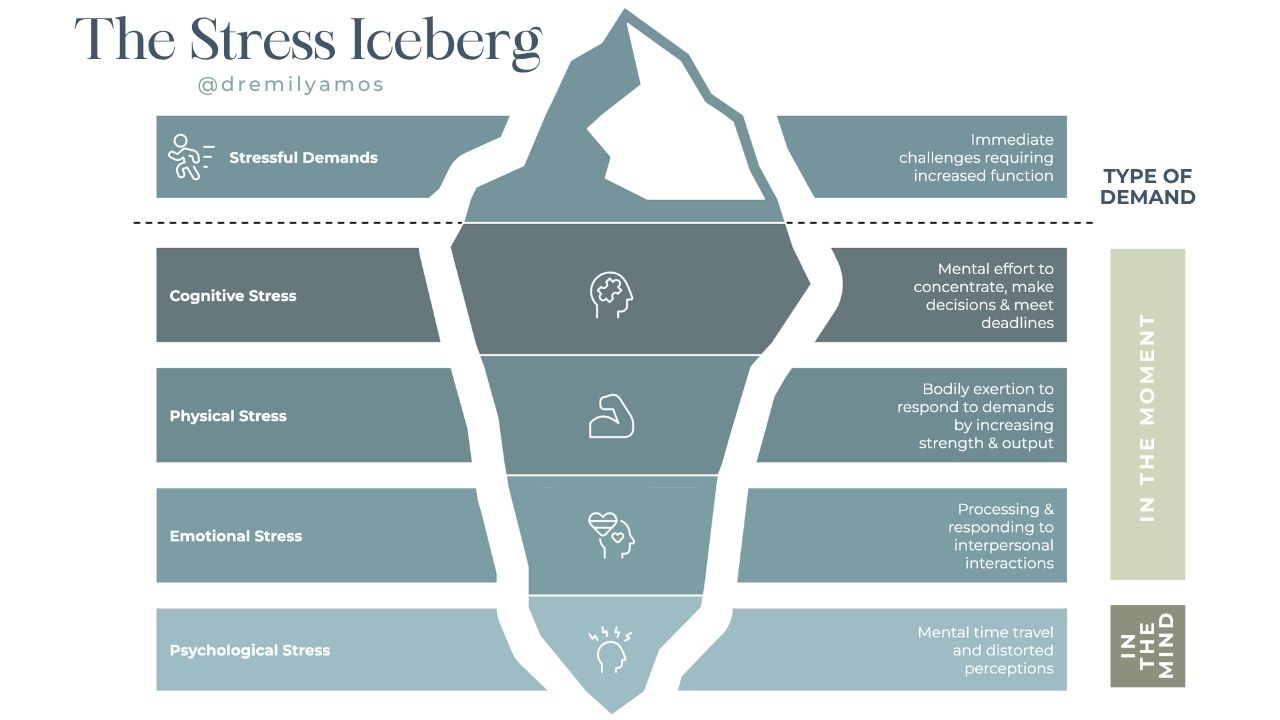
In each case, something in our environment signals to our body that it needs to add some fuel to the tank- increase the heart rate, get blood flowing to the brain and muscles, sharpen focus. All things that are genuinely useful when you're responding to an in-the-moment demand.
The problem is that stress isn't only triggered by what's happening right in front of us.
In this modern world, our brains have become expert time travellers, constantly pulling us back into the past to relive things that have already happened, or forward into the future to rehearse scenarios that haven't occurred yet and may never occur. Often, the biggest driver of our stress response isn't something real and immediate- it's the time travel of our own minds.
And this is where things start to unravel. Because unlike in-the-moment demands (which, I'd like to point out, you have a 100% track record of surviving), the demands we create in our minds never fully stop, and they rarely reflect what's actually happening right in front of us. Our minds have an extraordinary capacity to distort and amplify everything that passes through them.
Acute stress vs. chronic stress - why the difference matters
Not all stress is the same, and learning to tell the difference is one of the most important things I work on with the people I support.
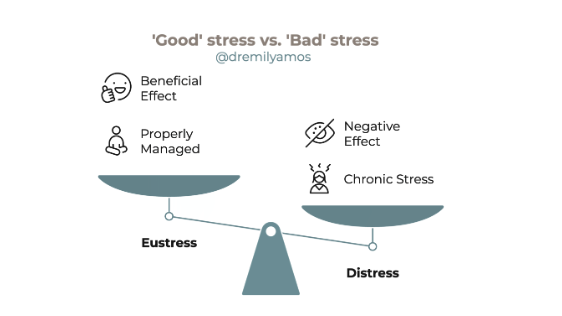
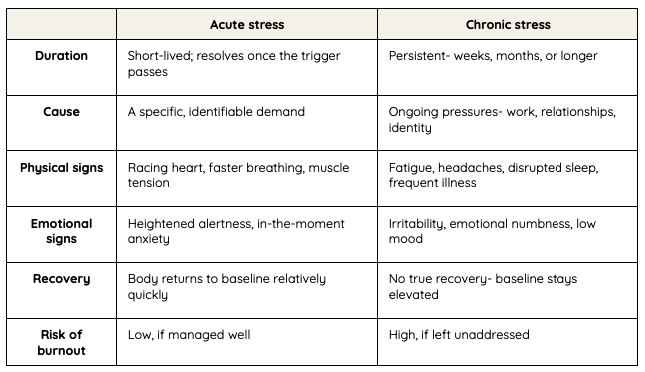
Acute stress is the kind your body is actually designed for. It builds in response to a specific demand, activates your system, and then settles back down once the demand has passed. It doesn't feel great in the moment, but it's purposeful and temporary.
Chronic stress is something else entirely. It's quieter, more insidious, and far more damaging over time. Many of us have been living with it for so long that it has become our "normal", and that's precisely what makes it so hard to see.
So what is burnout, and how is it different?
Burnout is currently defined as "a syndrome resulting from chronic workplace stress that has not been successfully managed." I'd argue this definition is too narrow. In all my years as a GP, coach, and yoga and meditation teacher, the biggest stressor I hear people talk about is trying to find a balance between work and home. Many people actually go to work to escape.
Whatever the precipitant, what we're really talking about is a stress system that can no longer respond to any increased demand. It often means that even basic challenges feel impossible. You may notice yourself stuck in one nervous system setting, whether that's constant fight-or-flight, or more commonly, freeze or fawn mode. There's a loss of enjoyment in things that once brought satisfaction, and an inability to connect meaningfully with the people around you. This is more than just stress, this is a system that is now completely in limp mode.
And limp mode, for those who haven't experienced it, is a very apt description. Just like a car that has been pushed past its limits and switches into a reduced-function state to protect itself from further damage, a nervous system in burnout isn't simply tired- it's protecting itself. It's not a character flaw. It's not weakness. It's what happens when a system has been left switched "on" for so long that the light bulb has finally gone out.
Warning signs that are worth paying attention to
Because burnout builds gradually, the early signs are easy to dismiss as just being tired or having a busy period. But your body usually starts communicating long before things reach a crisis point. Some of the most common signs I see:
- Exhaustion that sleep doesn't fix- you're resting but never actually feeling rested
- A growing sense of cynicism or detachment from work, relationships, or things that used to matter
- Working just as hard (or harder), but getting less done- simple decisions feel disproportionately heavy
- Difficulty mentally switching off, even when you're trying to rest
- Increased irritability or reactivity- a shorter fuse than you're used to
- Physical symptoms without a clear cause: headaches, digestive issues, recurring illness
- Loss of enjoyment in things you used to love
- A quiet but persistent sense that the way you're living is unsustainable
That last one is worth sitting with. If that inner voice has been getting louder, it's usually worth listening to.
What can you actually do about it?
The most important shift (and it sounds simple, but it isn't) is to stop accepting chronic stress as normal.
The stress response was designed to be temporary. It builds, it activates, it resolves. For many of us (my pre-burnout self very much included), the baseline has become a constant low hum of tension that we've normalised so thoroughly we barely notice it anymore. Learning to recognise the difference between acute and chronic stress is the first step. Once you can name what's happening, you start to have a choice about how you respond to it.
Practices like yoga and mindfulness can be genuinely useful here- not as a quick fix, but as a way to start reconnecting with your body's signals and rebuilding your capacity to regulate your own nervous system. I've written more about how yoga can specifically support stress recovery if you'd like to explore that further.
The stress response is meant to be a response to an in-the-moment demand. Something that builds, gets the body activated, then settles back down. When that never happens, something eventually has to give.
Maybe you've been carrying more than your fair share for too long. Maybe you're starting to question whether "pushing through" is really working anymore.
If that's you… you're not alone, and nothing is broken about you.
What you're feeling might not just be stress. It could be a sign that your body, your mind, your nervous system, has been trying to warn you about chronic stress for a long time- and is now asking for something different.
The good news is, once we start to see what's going on, we have the power to change it. It won't be overnight, and it's not always easy, but it is absolutely possible.
This is the work I do now, not just as a doctor, but as someone who has walked this path too. If you're curious about what it could look like to gently shift out of chronic stress and into something more sustainable, I'd love to support you.
Because burnout doesn't mean the end. For me, it was the very beginning.
Stay connected with news and updates!
Join the mailing list to receive the latest blogs, news and updates.
Don't worry, your information will not be shared.
We hate SPAM. We will never sell your information, for any reason.
